Religious of the Parish
Carrigtwohill's Parish Origins
Papal Taxation
Papal income tax was first levied by Innocent III in 1199, originally requiring the Catholic clergymen to pay one-fortieth of their ecclesiastical income annually in support of the Crusades. This taxation was superseded by the Fourth Lateran Council in 1215. By 1253, the phrase "ecclesiastical revenues and receipts" was defined.
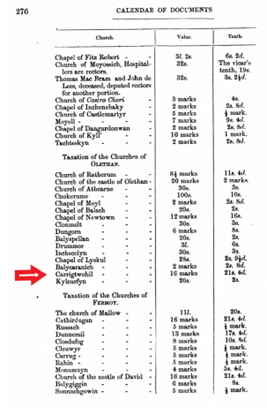
It was during Nicolaus IV Pontificate of 22nd February 1288 until his death, 4th April 1292, we first find ‘Carrugtochil’ and ‘Kylcurfyn’ appearing in the ecclesiastical Papal Tax returns for 1291; documented by Rev William Maziere Brady, D. D., in his Protestant ‘Clerical & Parochial Records of Cork, Cloyne, and Ross’, of 1864.
Henry Savage Sweetman, B.A., Trinity College, M.R.I.A, Barrister-at-Law, research into Ecclesiastical Tax for the period 1302-1307 was published soon after his death by Gustave Fredrick Hancock, on behalf of the Public Records office for ‘Her Majesty’s Treasury’ in 1886. Both Carrigtwohill and Kilcurfin taxes were valued respectively as 16 Marks, taxable at 21s 4d, and 20s with taxes of 2s. Furthermore, it confirms these churches came under the auspices Olethan (Castlelyons).
The ‘Mark’ was a currency in the form of a unit of weight, mainly for gold and silver, commonly used throughout Europe.
Then in 1319, the connection to Buttevant is evident when John de Barry of Carrigtwohill was petitioned under Ecclesiastical Law for the patronage by the Augustinian Ballybeg Priory near Buttevant.